
Previous page : Calculating pi - part 2
Next page : Trig from the compound formula

Adding angles
Remember that when we multiply complex numbers, we add their angles. So when multiplying 1+ib/n over and over again, we add a small angle over and over again. When this reaches –1, we have rotated half a turn. For our particular value 3.14… that we just found, and for large n this will happen when we have multiplied our number by itself n times.
In the following page, you can explore what happens with successive powers of 1+ib/n , for various values of b, starting with the number we found on the previous page.
We can adjust n and also b, starting with b = the value we previously found. Please explore this a bit.
Now set n to the maximum value and see what happens when you change the value of b. If b= 3,14…. you basically get a half circle. For half that value, a quarter of a circle, for twice the value, a complete circle and so on. How much you get of a circle is proportional to b. Also, the radius will be one. We have that

And, when multiplying complex numbers, we multiply their modulus, so

Then you may try to verify that

One way to do this is furher down the page.
.
.
,
,
.
.
.
.
.
.
.
So, we could rewrite the above as

But

so,

So, the distance to the origin will basically stay at 1.
Now, let us look at the half circle. We get that by adding up the smaller sides of n small triangles rotated about the origin.
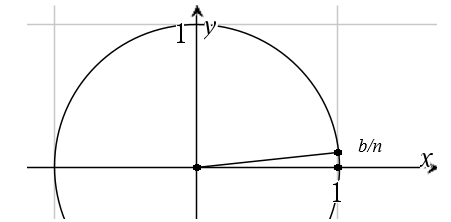
If n is large, the triangle’s height approaches the short side length, and in our case, that height is b/n, since our triangle represents the number 1+ib/n. The sum of those lengths is b, and that number will approach the arclength of a half a unit circle as n approaches infinity. The arclength of a half a unit circle is π, so b must indeed be π, and we have thus found a way of calculating π using the compound formula that was used to define e.
The values of e and π are indeed deeply connected. They are basically two sides of the same (circular) coin.
Radians
calculating that value, we added n small length b/n, but on the other hand, we have also added n small angles. It would then be quite natural to identify those lengths with the angles. That means that the value π could not just be seen as the arc length of half a unit circle, but also the angle 180°. This will be the angle unit radians where 180°=π.
One could argue that 180° is simply another way to write π.
Up a level : Euler's number e --- and a bit of piPrevious page : Calculating pi - part 2
Next page : Trig from the compound formula
Last modified: