Complex multiplication

Up a level : Complex numbers
Previous page : Complex number, an introduction
Next page : Complex powers

(In the end of this you may try an interactive page).
If we have that is z=a+bi and w=c+di then

\displaystyle \begin{array}{l}zw=\left( {a+bi} \right)\left( {c+di} \right)\\\quad \ =ac+bidi+adi+bci=ac-bd+\left( {ad+bc} \right)i\end{array}

A formula that works, but also a formula that does not get a feeling for what is actually going on – at least not for me.

From the introductory page we might see it worthwhile to examine if complex multiplication can be performed by multiplying the modulus (magnitude) of the two numbers and adding their arguments (angles). To examine this, we could try to see if

\displaystyle \left| z \right|\left| w \right|=\sqrt{{{{a}^{2}}+{{b}^{2}}}}\sqrt{{{{c}^{2}}+{{d}^{2}}}}

and

\displaystyle \left| {zw} \right|=\sqrt{{{{{\left( {ac-bd} \right)}}^{2}}+{{{\left( {ad+bc} \right)}}^{2}}}}

are equal by direct algebraic manipulation, but a faster method is to note that, if arg(z)=a and |z|=p, then

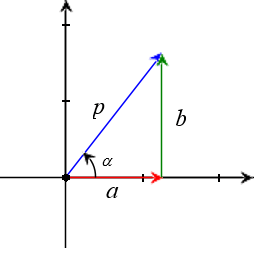
\displaystyle z=a+bi=p\cos \alpha +ip\sin \alpha =p\left( {\cos \alpha +i\sin \alpha } \right)

In a similar way we have

\displaystyle w=c+di=q\left( {\cos \beta +i\sin \beta } \right)

So,

\displaystyle \begin{array}{l}zw=p\left( {\cos \alpha +i\sin \alpha } \right)q\left( {\cos \beta +i\sin \beta } \right)\\\quad \ =pq\left( {\cos \alpha +i\sin \alpha } \right)\left( {\cos \beta +i\sin \beta } \right)\end{array}

And since

\displaystyle \left| {\cos \alpha +i\sin \alpha } \right|=\left| {\cos \beta +i\sin \beta } \right|=1

we indeed have that

\displaystyle \left| {zw} \right|=pq=\left| z \right|\left| w \right|

So now to the arguments.  We may expand the expressions with angles in them to get

\displaystyle \begin{array}{l}\left( {\cos \alpha +i\sin \alpha } \right)\left( {\cos \beta +i\sin \beta } \right)\\=\cos \alpha \cos \beta -\sin \alpha \sin \beta +i\left( {\sin \alpha \cos \beta +\cos \alpha \sin \beta } \right)\end{array}

But if

\displaystyle \arg (zw)=\arg (z)\arg (w)

then

\displaystyle wz=pq\left( {\cos \left( {\alpha +\beta } \right)\ +i\sin \left( {\alpha +\beta } \right)} \right)

For this to be true we must have that

\displaystyle {\cos \left( {\alpha +\beta } \right)+i\sin \left( {\alpha +\beta } \right)}

must be equal to

\displaystyle \cos \alpha \cos \beta -\sin \alpha \sin \beta +i\left( {\sin \alpha \cos \beta +\cos \alpha \sin \beta } \right)

Or that

\displaystyle \left\{ \begin{array}{l}\cos \left( {\alpha +\beta } \right)=\cos \alpha \cos \beta -\sin \alpha \sin \beta \\\sin \left( {\alpha +\beta } \right)=\sin \alpha \cos \beta +\cos \alpha \sin \beta \end{array} \right.

But in this we might recognise the compound angle formulas for cos and sin, and since they are true, we do have that

But in this we might recognise the compound angle formulas for cos and sin, and since they are true, we do have that

QED.

To get a feeling for this you might test this interactive page:

Up a level : Complex numbers
Previous page : Complex number, an introduction
Next page : Complex powersLast modified: Nov 9, 2025 @ 20:55